
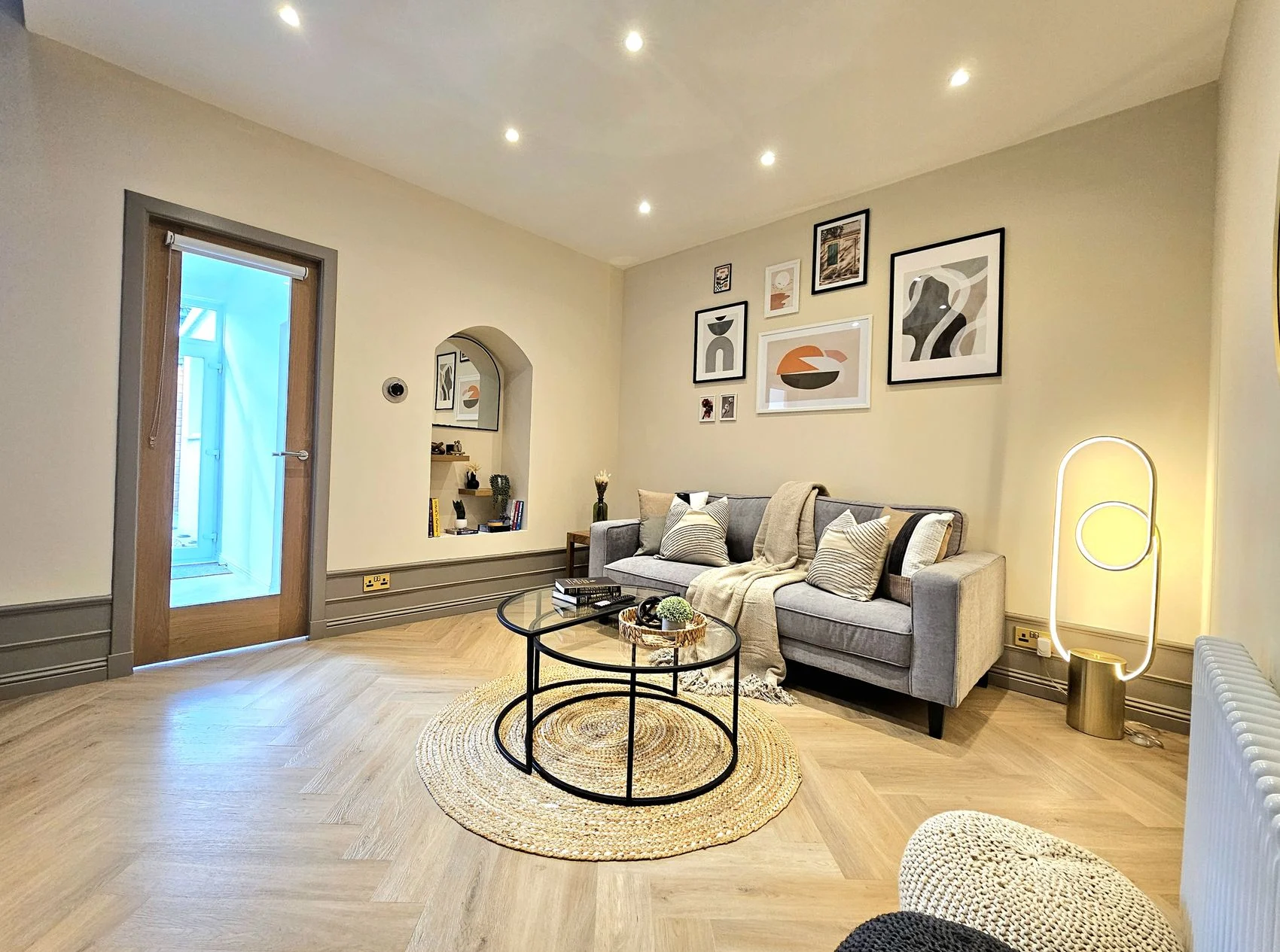
3 Bed Terraced
House Glasgow.
A cash-purchased Glasgow property fully renovated and prepared for short-term let performance.
This case study covers how a 3 bed terraced house in Glasgow was acquired, fully renovated and run as a short-term let — purchased in cash, upgraded and renovated for consistent performance.
The Property.
This property required full renovation before it could perform effectively as a short-term let. The strategy was not a light refresh — it was a full repositioning project designed to improve usability, presentation and long-term performance.
The layout is a two-storey terraced property with defined living space, a separate kitchen and three bedrooms suited to families and contractor bookings. The quality of scoping, budget control and design decisions had a direct impact on final performance.
The Numbers.
Actual performance data drawn from recorded results.
Before AirUs.
After AirUs.
The property was acquired as a cash purchase requiring full renovation before it could perform effectively as a short-term let. With a long-term rent alternative of £14,400 per year and no letting model in place, the asset needed full repositioning — not a light refresh — to unlock its commercial potential as a managed short-term let property.
The property was taken through a full renovation for short-term use, with layout improvements and practical fit-out. Ongoing management covers pricing, guest standards, cleaning and reporting — resulting in £53,045 gross revenue, a 4.9/5 average guest rating and a 19% NET yield on total capital deployed.
View The Renovation.
See the full renovation, including the before and after transformation of this property.
View RenovationTo view more renovations we have completed throughout the UK, visit our socials.
How The Property
Is Operated.
The property is operated through a structured short-term let model with pricing adjusted throughout the year in line with demand. Guest standards and house rules are applied consistently, while cleaning, linen and maintenance are coordinated through defined systems — particularly important in a heavier renovation project where protecting invested capital is as critical as generating income.
Considerations For This Model.
- Higher upfront capital exposure than lighter refurbishment projects
- Greater exposure to scope drift, cost overruns and delays if renovation planning is weak
- Seasonal demand variation and ongoing licensing requirements affect performance over time
- Full cash purchase means no mortgage leverage — all capital is deployed upfront
- Long-term performance depends on protecting the renovation investment through consistent management
- Investors comfortable deploying higher upfront capital into a full refurbishment
- Those who understand refurbishment-led repositioning and controlled renovation budgets
- Investors who prefer full ownership without mortgage leverage
- Those who value predictable yield over leveraged return
- Operation remains subject to local licensing and regulatory approval where applicable
More Than Just
Higher Income.
Capital-intensive projects require more than strong renovation quality. The difference between a refurbishment project that performs and one that underperforms is rarely the finish level alone — it is the discipline applied to acquisition cost, renovation scoping and management standards once the property is live.
Strong short-term let performance from a full refurbishment is built on acquiring correctly, controlling renovation spend and then managing the asset with the same discipline that shaped the setup. When those are aligned, a property like this can produce a strong and sustainable NET yield over the long term.
Apply For A
Manual Review.
Each property is reviewed individually and this case study is provided for context rather than as a guarantee of future performance. If you want to assess whether a similar property could work as a structured short-term let investment, apply below.